
The Great Game Comes to Bangladesh
China is selling the weapons, Russia is building the reactors, Pakistan is making friends, and India is losing its patience. Washington hasn't yet noticed.

Americans can be forgiven for knowing relatively little about Bangladesh. It rarely dominates international headlines, has never been particularly fashionable among Washington's foreign-policy commentators, and is generally mentioned in the United States when something unfortunate happens to a garment factory.
Still, it is home to more than 170 million people – roughly half the population of the United States – crammed into an area about the size of the state of Illinois, and it produces an astonishing quantity of the clothes Americans wear. It also occupies a piece of South Asian real estate that would make any military strategist salivate. Its misfortune, apparently, is that it has never been particularly fashionable among Washington's foreign-policy establishment. Maybe they don’t care, or maybe they forgot.
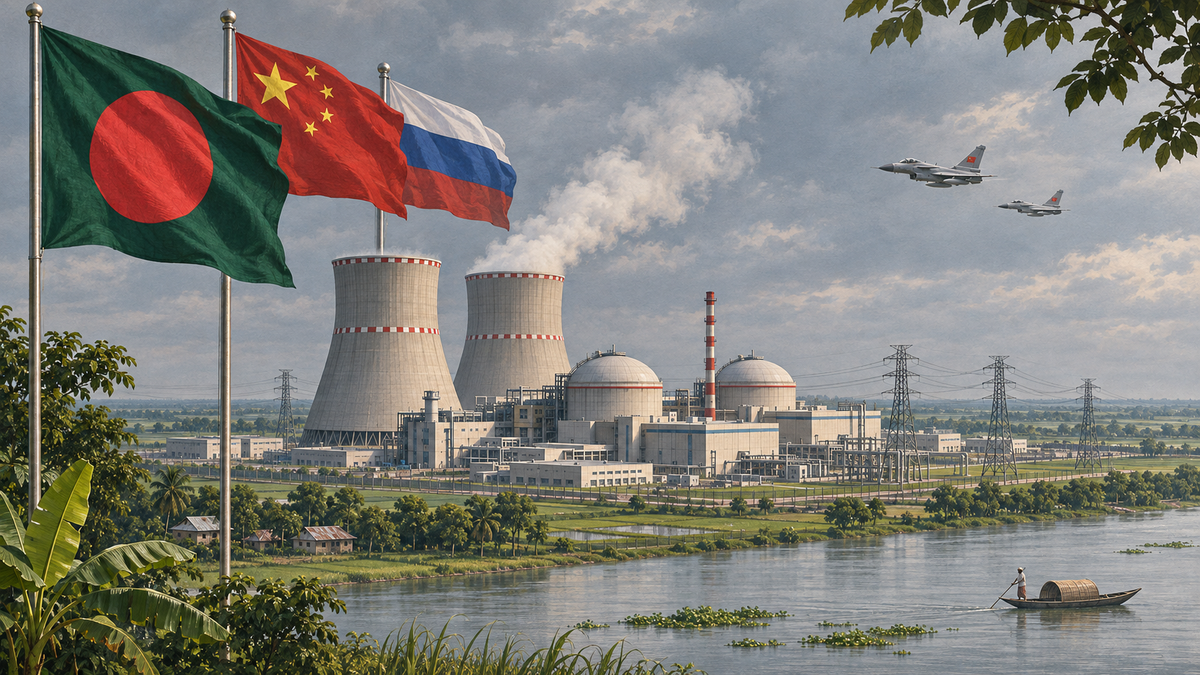
The Chinese, Russians, and Pakistanis, however, have been considerably less forgetful. Since the overthrow of Sheikh Hasina in August 2024, all three have been pursuing opportunities in Bangladesh, and none of them are going to wait around for Washington to notice. Beijing is expanding its already enormous share of the country's military hardware, Moscow has all but completed a $12.6 billion nuclear power plant, and Islamabad is rediscovering its affection for a country that fought a bloody war to get away from it at the cost of millions of Bengali lives.
India, which helped secure Bangladesh's independence in 1971 and spent much of the past decade enjoying unusually cordial relations with Dhaka, is discovering that historical gratitude has a rather short shelf life. Its closest political ally in Bangladesh is now living in exile on Indian soil, anti-Indian and anti-Hindu sentiment has become a convenient political commodity, and China's defense contractors are enjoying a shopping spree next door.
It’s all rather unfortunate for Washington, which has spent years lecturing the world about the importance of its Indo-Pacific strategy while allowing an increasingly important corner of that region to become the centerpiece of everyone else's strategic ambitions.
The Chinese military catalogue
China's relationship with Bangladesh is nothing new. Beijing has been Dhaka's principal arms supplier for years, providing everything from submarines and naval vessels to armored vehicles, fighter aircraft, and missile systems. Bangladesh's armed forces have consequently developed an enduring familiarity with Chinese technology, which is very convenient for the manufacturers who would like to sell them more of it.
The relationship has only become more ambitious since Hasina's departure. In January 2026, the Bangladesh Air Force signed an agreement with China Electronics Technology Group Corporation International, or CETC, to establish a domestic drone manufacturing and assembly facility. The agreement includes technology transfer, training, and the eventual domestic production of unmanned aerial vehicles, including medium-altitude, long-endurance drones and vertical-takeoff-and-landing systems.
This might not sound like much more than the usual day-to-day machinery of a country’s foreign relations apparatus, there is an important distinction between selling another country a few dozen drones and helping that country manufacture them. The former provides a customer with equipment; the latter directly embeds the supplier within the customer's defense industry. Machinery, technical expertise, maintenance infrastructure, and trained personnel create dependencies that are much harder to discard than a shipment of imported weapons. Beijing is selling Bangladesh the means to build its own military equipment, although naturally with a generous helping of Chinese technology.
The proposed factory's location in the Bogura area of northern Bangladesh is also worth examining. It is relatively close to the Indian frontier, a detail unlikely to have escaped the attention of New Delhi's defense establishment. Geography alone is no evidence of hostile intentions, and there are perfectly ordinary logistical reasons for locating military industries near existing air force facilities. Nevertheless, when your increasingly difficult neighbor begins producing Chinese-designed military drones a short distance from your border, it is understandable that you might take an interest.
The aircraft negotiations aren’t any more reassuring. Bangladesh has been pursuing the acquisition of Chinese J-10CE multirole fighters, with discussions reportedly involving as many as two dozen aircraft. The aircraft is an impressive enough machine, equipped with modern radar and capable of carrying advanced beyond-visual-range missiles. Its Pakistani operators have made much of its performance following the May 2025 India-Pakistan fighting, and Beijing has been only too happy to advertise its credentials.
The procurement has not been finalized publicly, and discussing a fighter jet is not quite the same thing as purchasing one. But the negotiations point to a larger trend. Bangladesh's military modernization program is increasingly being shaped around Chinese systems, Chinese industrial cooperation, and the long-term technical support that accompanies them.
Beijing has little reason to complain. It gains another customer for its defense industry, another foothold in India's neighborhood, and an opportunity to cultivate influence without the bother of formally stationing troops anywhere. The arrangement they’ve reached is somewhat more elegant than an invasion, and significantly cheaper.
India and its ungrateful neighbors
For India, this entire affair has a particularly bitter historical flavor.
In 1971, the Indian military intervened during Bangladesh's war of independence, helping defeat Pakistani forces after months of mass atrocities and an enormous refugee crisis. The historian Robert Payne writes that upwards of 3 million Bengalis were killed and over 100,000 women were raped as an instrument of warfare by the Pakistani army. Bangladesh’s independence was secured in December of that year, and India has remained an indispensable neighbor ever since. The two countries share an extensive border, important trade relationships, waterways, and security concerns that cannot be wished away by whichever government happens to be in office.
Under Sheikh Hasina, relations were particularly close. Her Awami League government generally maintained friendly ties with New Delhi, cooperated on security matters, and provided India with a relatively dependable partner on its eastern frontier. There were plenty of Bangladeshis who resented this closeness, particularly those who considered Hasina's government excessively deferential to Indian interests, but the relationship was useful to both countries.
Then came August 2024. Hasina's increasingly authoritarian administration was collapsed by enormous student-led protests, and the former prime minister fled to India, where she has remained a source of considerable diplomatic irritation. Her departure left New Delhi associated with a deeply unpopular former ruler, while the political movements that replaced her had every incentive to demonstrate their independence from Indian influence.
The resulting deterioration was predictable. Anti-India rhetoric became more prominent, concerns over violence against Bangladesh's Hindu minority aggravated tensions, and politicians in Dhaka began presenting closer relations with other powers as evidence of a newly independent foreign policy.
One might reasonably ask how independent that policy becomes when its practical consequence is replacing Indian influence with Chinese military technology, Russian nuclear financing, and renewed courtship from Pakistan. It’s an odd conception of sovereignty that regards cooperation with the neighbor who helped establish your country as servitude, but billions of dollars in foreign military contracts as liberation.
That is not to say Bangladesh should simply subordinate itself to India's interests. Dhaka has every right to pursue its own economic and security relationships, and New Delhi has not always been the easiest neighbor. But India remains Bangladesh's most consequential regional relationship, regardless of what a politician might say at a rally. The consequences of alienating it are unlikely to disappear because the Chinese have offered a competitive price on fighter jets.
Pakistan remembers an old acquaintance
Of all the countries seeking to improve their position in Bangladesh, Pakistan's renewed enthusiasm is perhaps the most extraordinary.
The two countries were once part of the same state, united principally by religion and separated by an inconvenient thousand miles of Indian territory. The arrangement ended rather badly in 1971, when Pakistan's military attempted to suppress Bengali independence through a campaign of mass killing, displacement, and sexual violence. Local Islamist collaborators, including elements associated with Jamaat-e-Islami, supported the Pakistani war effort. Bangladesh eventually emerged independent, while Pakistan lost its eastern half and a considerable portion of its national prestige.
It was hardly the sort of separation that normally inspires affectionate reunions.
Yet Pakistan has been making a concerted effort to improve relations with Dhaka following Hasina's overthrow. Diplomatic exchanges, commercial discussions, and the prospect of renewed defense cooperation have all attracted attention. Bangladeshi interest in the JF-17 Thunder, a fighter developed jointly by Pakistan and China, would, if it resulted in a purchase, make the military relationship particularly interesting.
Islamabad has an obvious strategic incentive. It has spent decades contesting India's influence across South Asia, often with limited success, and an opportunity to cultivate closer relations on India's eastern flank is not one it is likely to refuse. Bangladesh, meanwhile, can use renewed contact with Pakistan to remind New Delhi that it has other diplomatic options.
There have also been more sensational allegations surrounding Pakistan's activities during the 2024 uprising. Some commentators have accused Pakistan's Inter-Services Intelligence agency of helping orchestrate the unrest that brought down Hasina, with claims circulating about foreign weapons, covert support, and a coordinated effort to reestablish Pakistani influence in Bangladesh.
Such accusations deserve investigation, but they cannot responsibly be treated as established facts. The uprising had substantial domestic causes, including the brutality and authoritarianism of Hasina's government, and a United Nations investigation subsequently documented serious abuses by the security forces during the protests. Pakistan could certainly seek to exploit the political consequences of Hasina's downfall without having engineered the events that brought it about.
In any case, Islamabad hardly needs to have organized a revolution to benefit from it. The collapse of a government closely aligned with India has already given Pakistan opportunities that scarcely existed two years ago. Whether it can convert those opportunities into lasting influence is another matter.
There remains the awkward business of 1971, of course. Historical memory can be surprisingly resilient, especially when the events in question involved the murder of one's countrymen. Pakistan may find that improving relations with the Bangladeshi government is somewhat easier than persuading Bangladeshis to forget why their country exists in the first place.
Russia prefers the nuclear option
While Beijing sells weapons and Islamabad exchanges diplomatic pleasantries, Moscow has pursued a quieter, and potentially more enduring, form of influence. Russia's state-owned nuclear corporation, Rosatom, has been constructing Bangladesh's first nuclear power station at Rooppur, approximately 100 miles northwest of Dhaka. The facility comprises two Russian-designed VVER-1200 reactors with a combined planned generating capacity of 2,400 megawatts. The project is estimated to cost around $12.65 billion, with Russia providing financing for as much as 90 percent of the total.
On November 17, the plant's first reactor began supplying electricity to Bangladesh's national grid during trial operations, marking a genuine milestone for the country's energy sector. Bangladesh has long struggled with electricity shortages, expensive imported fuels, and the demands of a rapidly industrializing economy. Nuclear power, which I have always regarded as one of the most sensible forms of electricity generation available, offers obvious economic and practical advantages. Unfortunately, it comes with a Russian invoice.
The difficulty with purchasing a nuclear power station from Moscow is that one is not simply purchasing a large building that produces electricity. One is entering into a relationship involving specialized nuclear fuel, technical expertise, maintenance, replacement components, and financing that can continue for decades. Rooppur is designed for a service life extending well into the latter half of this century, which means that Bangladesh's relationship with Rosatom could outlast several generations of political leaders.
The financial arrangements have already proved troublesome. Western sanctions imposed following Russia's invasion of Ukraine complicated payment mechanisms for the project, prompting Moscow and Dhaka to renegotiate aspects of their loan agreements. In February 2026, Russia's parliament ratified amendments addressing payment difficulties and extending the availability of project financing into 2027.
This is a rather effective way of acquiring influence. There is no need to establish a Russian military base or demand ideological allegiance from Bangladesh's government. Moscow has simply made itself an important part of the country's energy future, with a substantial financial relationship to accompany it.
Nor is Bangladesh likely to abandon the project merely because the Americans object to Russian influence. After spending billions of dollars on the facility, Dhaka has every incentive to make it work. The Russians understand this perfectly well, which is presumably why they are so enthusiastic about building nuclear reactors abroad.
Washington discovers the Bay of Bengal
All of this ought to concern Washington, although not necessarily for the reasons that typically dominate American diplomatic discussions about Bangladesh. The United States has legitimate reasons to care about the country's democratic institutions, religious freedom, and treatment of minorities. Bangladesh's recent political history provides ample cause for concern on all three fronts. But it would be a mistake to imagine that America's relationship with Dhaka can be managed exclusively through human-rights statements, diplomatic visits, and solemn declarations about democratic values.
Bangladesh sits along the Bay of Bengal, adjacent to one of America's most important strategic partners, India. Its ports and maritime approaches have significance for regional trade and security. Its manufacturing sector is heavily integrated into Western markets, and its considerable population makes it one of the most important states in South Asia.
China understands the geography. Russia understands the commercial opportunities. Pakistan understands the implications for its rivalry with India. It is not entirely clear that Washington has always regarded Bangladesh with the same seriousness.
American officials have sought to expand defense and commercial engagement with Dhaka, including discussing alternatives to Chinese military equipment. There is certainly room for such cooperation. Bangladesh's armed forces have legitimate modernization requirements, and American technology could offer attractive options in aviation, surveillance, communications, and maritime security.
But the United States cannot expect to displace established Chinese suppliers merely by informing the Bangladeshis that Chinese equipment is undesirable. Beijing has spent years developing relationships with the country's military establishment, and the prospect of domestic assembly, technology transfer, and financing makes its offers considerably more attractive than a lecture about strategic competition.
Nor can Washington expect Bangladesh to sever its Russian nuclear relationship. Rooppur is already built, its first reactor has begun producing electricity, and its financial obligations will remain long after the current diplomatic disputes have been forgotten.
A more sensible American policy would concentrate on creating alternatives where they are still possible. Greater investment, credible defense partnerships, energy infrastructure, maritime cooperation, and access to American technology would provide Bangladesh with choices that reduce its dependence on any single foreign power. Washington should also encourage a workable relationship between Dhaka and New Delhi, rather than allowing mutual resentment to become another gift to Beijing.
This would require treating Bangladesh as a serious strategic partner with its own interests, rather than a minor country expected to arrange its foreign policy according to Washington's preferences. The Bangladeshis have endured enough foreign powers informing them what their national interests ought to be.
The next contest for Bangladesh
The political transformation of Bangladesh has produced a peculiar geopolitical situation. Its newly elected BNP government must manage relations with an India still sheltering its deposed predecessor, a China eager to deepen military cooperation, a Russia holding billions of dollars in nuclear investments, and a Pakistan hoping that the unpleasantness of 1971 might eventually become ancient history.
It must do all this while addressing an economy in need of reform, an increasingly confident Islamist opposition, and the considerable expectations of voters who were promised a new political beginning after years of authoritarian government.
There is no evidence that Bangladesh has decided to join some grand anti-American coalition, nor would such an alignment make much economic sense. The country depends heavily on international commerce and has good reason to maintain productive relations with the United States, Europe, India, and its other partners. Its foreign policy has traditionally relied on balancing competing relationships rather than committing itself exclusively to one camp.
The danger lies in how those relationships develop over time. A Chinese drone factory may be commercially attractive. A Russian nuclear plant may be economically necessary. Renewed trade with Pakistan may serve perfectly reasonable diplomatic purposes. But accumulated together, these arrangements can gradually give foreign governments influence over sectors of Bangladesh's economy and national security that will be difficult to unwind. For a country whose independence was won through an exceptionally bloody struggle against foreign domination, that would be an unfortunate irony.
Washington need not panic, and it certainly need not attempt to turn Bangladesh into another American client state. It should, however, recognize that an important political and strategic contest is taking shape in a country it has too often treated as an afterthought.
China has come with its fighter jets, Russia with its nuclear reactors, and Pakistan with a conveniently refreshed memory of brotherly relations. India is watching from over the fence with understandable displeasure.
The United States still has an opportunity to influence the outcome. It might begin by showing up with something more substantial than another speech about the rules-based international order.