The curious case of Uthman Ibn Farooq
An 'Islamophobic' stabbing, a mysteriously absent convict, $5,000 in unclaimed reward money, and my rather undignified expulsion from a Colorado mosque.

Some years ago, the American public was treated to one of the great theatrical productions of modern grievance politics. Jussie Smollett, an actor on the television series Empire, claimed that two Trump supporters had assaulted him on a freezing Chicago night, shouting racist and homophobic abuse while equipping him with a noose. The attackers had apparently been wandering the streets at two in the morning, armed with bleach and MAGA slogans, when they happened upon the minor television celebrity. It was a remarkably convenient encounter, although not nearly as convenient as the subsequent discovery that Smollett had arranged the whole thing himself.
The affair became an international embarrassment, and rightly so. There was something wonderfully preposterous about the idea of two racist Trump supporters roaming the streets of Chicago in the dead of winter, carrying the necessary theatrical accessories in case they happened upon a gay black actor. Even the most credulous observers eventually had to confront the possibility that the story had been written by somebody with a rather poor understanding of how racist criminals actually behave.
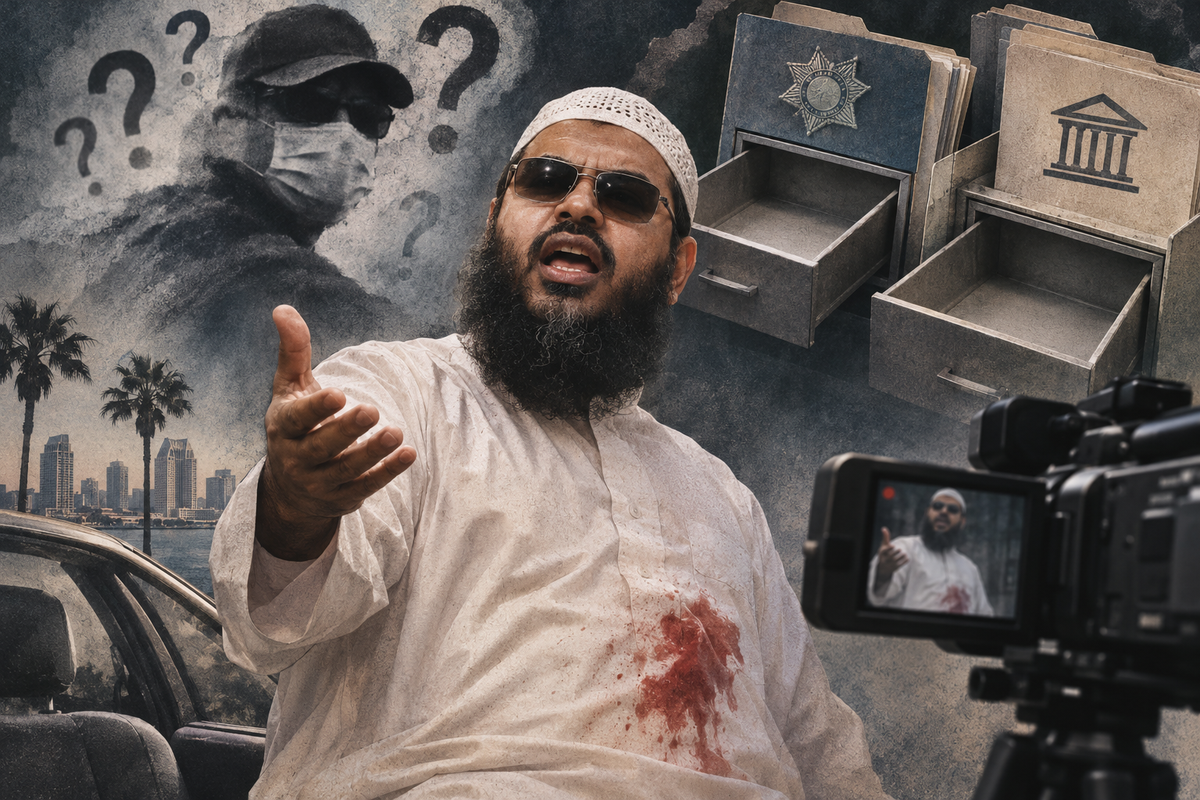
A name considerably less familiar to Americans, although well known to millions of Muslims around the world, is Sheikh Uthman Ibn Farooq, a San Diego-based Islamic preacher whose own account of an 'Islamophobic' assault possesses some of the same qualities. Farooq has cultivated a rather entertaining public character, part Islamic scholar, part street preacher, and part reformed gangster who appears determined that nobody should forget the gangster part. His accounts of growing up around gangs and violence feature prominently in his public testimony, and his later appearances alongside internet provocateurs such as Sneako have done little to diminish the impression of a man who would be quite pleased to have his religious credentials confused with those of a hardened criminal.
Farooq is, in other words, the sort of preacher who might interrupt a theological discussion to remind you that he grew up in the hood. It is a curious affectation for a man whose principal occupation is inviting strangers to embrace Islam, but evidently the modern missionary must possess a certain street credibility. One can imagine Saint Augustine taking a similar approach to his Confessions, pausing occasionally to remind readers that he was not to be messed with back in Carthage.
In March 2022, Farooq announced that he had been stabbed by a racist 'Islamophobe' in San Diego. The circumstances were so wonderfully theatrical that they might have been rejected from the Smollett screenplay for being insufficiently believable.
A most obliging 'Islamophobe'
According to Farooq, he had been sitting in his vehicle when a white man wearing a COVID mask approached him and began shouting anti-Muslim abuse. The stranger apparently recognized the preacher from his videos, denouncing him as a terrorist before the encounter escalated.
The mask was an especially charming detail. Here was an apparently rabid right-wing 'Islamophobe' who, despite his alleged willingness to commit a violent hate crime, remained sufficiently conscientious about public health to cover his face outdoors. Perhaps he was concerned about transmitting COVID to the Muslim he was about to stab. Even the most committed bigot must observe certain standards of respiratory hygiene.
Farooq, who had conveniently been recording the encounter, responded with the sort of dialogue one might expect from a man auditioning for a low-budget action film. “You think I'm scared of you?” he demanded, apparently drawing upon his extensive experience of the mean streets.
Then, the camera abruptly stopped recording.
What happened next, according to Farooq, was a violent altercation in which the preacher fought off his knife-wielding attacker, disarmed him, and suffered a stab wound to the abdomen. It was an impressive performance for a man supposedly on his way to a dentist's appointment. One moment he was attending to his oral hygiene, the next he was engaged in mortal combat with a masked 'Islamophobe' who had somehow recognized him from YouTube.
Apparently, Farooq had also decided that an 8 a.m. dentist’s appointment called for the full ceremonial splendor of his immaculate white Islamic robes, as though he were on his way to deliver the Friday khutba rather than have his molars inspected.
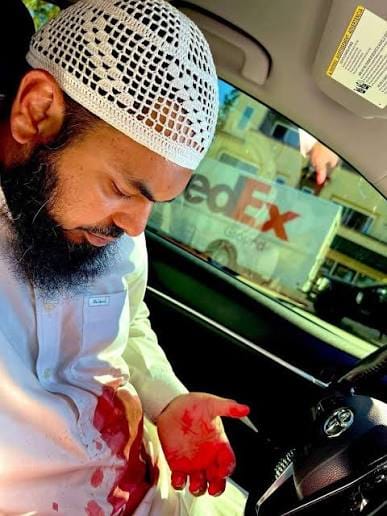
Having survived this encounter, Farooq apparently found time to photograph himself sitting in his vehicle, his white Islamic tunic decorated with a conspicuously bright red stain. The photograph circulated alongside his account of the attack, offering his followers a suitably dramatic image of their wounded hero.
Here is his grandiose and heroic account of what happened:
“I toss my phone, we get into it. Alhamdulillah, I was able to get some good hits but as you can see he didn’t touch me… and he was taller than me!” he boasted. “Instinctually, I grabbed his right hand, and during this struggle, he grabbed the knife. But Alhamdulillah, I was holding his hand, so he wasn’t able to get a good stab – just a slice. I didn’t feel any pain. […] I grabbed his hand with two hands, and I started twisting his wrists until he dropped [the knife]. When he dropped it, I went to get the knife and he ran away like [a] coward.”
The picture raised questions of its own. The placement of the stain appeared difficult to reconcile with the location of the injury Farooq subsequently indicated beneath a bandage, although photographs are notoriously unreliable instruments for reconstructing wounds. The blood seemed remarkably bright, and its distribution invited speculation about how it had traveled across the fabric. While none of these observations, individually or collectively, establishes with certainty that the injury was fabricated, they did, however, make the photograph a much less satisfactory substitute for medical documentation than Farooq's admirers appeared to believe.
There was also the peculiar matter of the recording. Farooq had managed to capture the arrival of a conveniently recognizable villain, complete with anti-Muslim insults and a face covering, but the footage ended before the alleged stabbing. Perhaps the recording stopped for an entirely innocent reason. Perhaps the phone was knocked aside during the struggle. Whatever the explanation, the available video documented a confrontation while leaving the most serious allegation unrecorded.
The story nevertheless spread internationally. Muslim news outlets in Britain, Nigeria, and South Africa reported the alleged attack, while the Council on American-Islamic Relations condemned it. Farooq's supporters were outraged, and his reputation as a fearless defender of Islam was hardly diminished by the account of his victory over an armed assailant.
It was an extravagant story, but I thought it might benefit from a little verification.
The police appear to have misplaced a stabbing
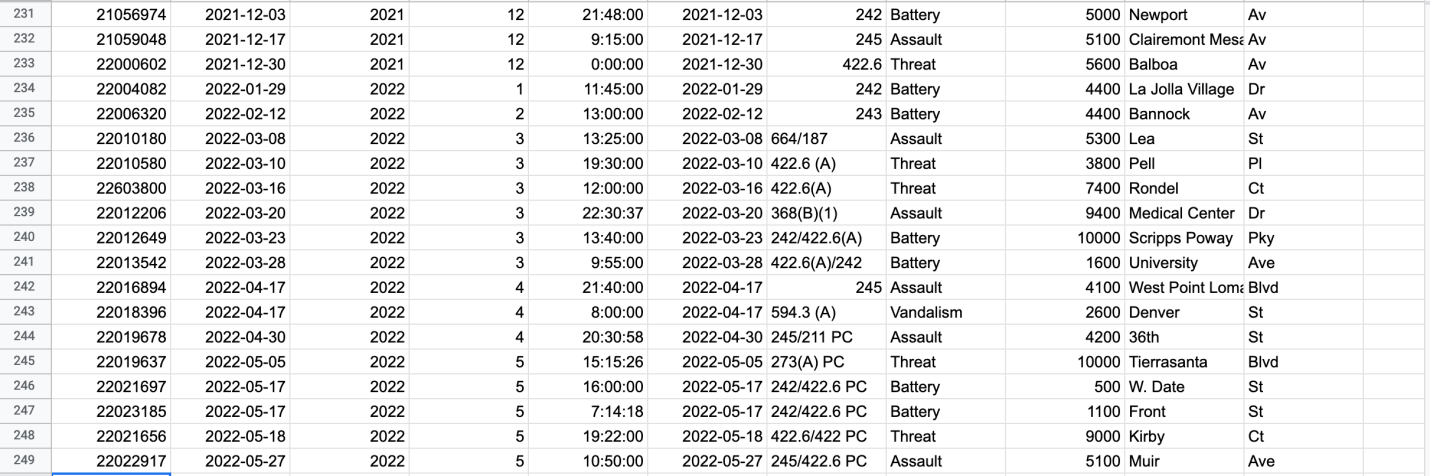
At the time, I was working as an investigative reporter for the Middle East Forum's Focus on Western Islamism project. After reading Farooq's account and watching the footage, I contacted the San Diego Police Department to establish what had happened.
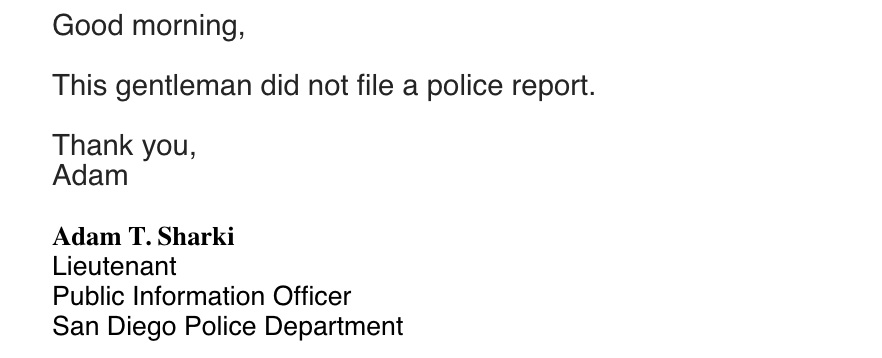
Lieutenant Adam Sharki, the department's public information officer, informed me that the police could locate no corresponding criminal case. A stabbing reported to the department would ordinarily generate a case, he explained, yet no such record existed. The department also had no record of an arrest connected to the alleged incident.
This was an unfortunate development for Farooq, who had already told his followers that he had reported the matter to the authorities. It became considerably more unfortunate when he subsequently announced that his attacker had been arrested, prosecuted, convicted, and incarcerated.
The masked 'Islamophobe' had apparently completed a remarkably efficient journey through the California criminal justice system without troubling its record-keepers.
My first investigation appeared in October 2022. Farooq responded with considerable indignation, dismissing our reporting as the work of a little 'Islamophobic' website, apparently operated by somebody sitting in a basement. He insisted that his attacker had pleaded guilty to lesser offenses and was serving time in jail.
Farooq also announced that he intended to visit the prisoner and invite him to Islam. It was a touching gesture of forgiveness from a man who had allegedly spent his youth among gangsters. The former street tough had apparently become so magnanimous that he wished to convert the very man who had tried to kill him.
Still, there remained the minor inconvenience of establishing that the prisoner existed.
I contacted the San Diego County District Attorney's Office, whose public information officer, Tanya Sierra, informed me that the office had received no such case from law enforcement. A supporter of Farooq then suggested that I had been contacting the wrong police department, and that the incident had actually been reported to the La Mesa Police Department, whose jurisdiction ended miles from the apparent location of the encounter. So I contacted La Mesa; nothing there either.
My inquiries eventually reached Farooq's nonprofit, the One Message Foundation. When I asked which police department had handled the matter, a representative advised me to try both. It was sound advice in the same sense that searching every drawer in one's house is sound advice when looking for a missing pair of socks, although somewhat less satisfactory when attempting to identify the agency responsible for prosecuting a violent criminal.
The California authorities were proving remarkably uncooperative with Farooq's narrative. The San Diego police had no report, La Mesa had no report, and the district attorney had no prosecution. Subsequent inquiries reported by my colleagues produced no corresponding record from the California attorney general's office either. The man had supposedly been arrested, convicted, and imprisoned, yet his name, his case number, and the identity of the prosecutor remained elusive.
One might have expected Farooq to welcome the opportunity to settle the matter. After all, he claimed to possess the court documents. Instead, he announced that he would provide the evidence to a legitimate news organization, a category from which I had apparently disqualified myself by asking to see it.
Five thousand dollars for a court docket
The Middle East Forum eventually decided that a little financial encouragement might persuade Farooq to produce the documents he had so frequently assured his followers were in his possession.
On November 27, 2022, MEF offered him $5,000 to identify his attacker, provide the relevant court docket number, and name the prosecutor and police officer involved in the case. The offer was unusually generous, considering that Farooq had already claimed to possess everything necessary to collect it.
There was no requirement to perform a dangerous stunt, confront another armed assailant, or return to the gang-infested streets of his youth. He merely had to provide the paperwork for a criminal conviction he insisted had already occurred.
In one video response, Farooq brandished a stack of documents at the camera while insisting that he possessed the proof and was under no obligation to show it to his critics. It was an extraordinary approach to evidentiary disclosure. For a brief moment, the audience was permitted to behold what appeared to be paper. Whether it was a police report, a court filing, a dentist's bill, or the instructions for assembling an IKEA bookshelf remained anybody's guess.
His followers appeared satisfied. The mere sight of documents, whatever their contents, was evidently enough to settle the matter. The documents themselves were not made available for independent examination, which seemed a rather important omission given that their entire purpose was supposedly to establish the truth of Farooq's account.
Farooq did not respond to MEF's offer before the November 30 deadline. According to the organization's subsequent announcement, he instead indicated that the evidence would appear in a forthcoming documentary about his missionary activities.
A documentary was certainly an imaginative solution. The name of a convicted criminal, ordinarily discoverable through the rather unglamorous machinery of court records, had apparently become a cinematic revelation requiring its own production schedule. One could almost hear the dramatic music as the camera slowly approached a filing cabinet.
The five thousand dollars went unclaimed. The documentary promise did not supply the identifying records requested by MEF, and the alleged prosecution remained unverified.
My own brush with Uthman Ibn Farooq
By this point, I had spent several weeks attempting to establish the identity of a man who was supposedly already sitting in jail. The police couldn't identify him, the prosecutor couldn't identify him, and Farooq's organization couldn't tell me which authorities had dealt with him. The preacher himself, meanwhile, appeared considerably more interested in denouncing my investigation than resolving it.
Then I learned that Farooq would be appearing at the Colorado Muslims Community Center in Aurora, not terribly far from where I lived. This presented an opportunity to ask him directly, face to face, about the missing prisoner.
The event was the Authentic Ilm Mission conference in November 2022. I attended and asked Farooq for the identity of the man he claimed had been convicted of stabbing him. It seemed a modest request, particularly for a preacher whose public biography included surviving gang violence and defeating an armed attacker.
Farooq responded by accusing me of dishonesty and 'Islamophobia.' He began denouncing me before the congregation, which soon joined in chants of Allahu Akbar. The mosque's imam, Karim Abu Zaid, then intervened and physically escorted me from the premises.
Abu Zaid and I are no strangers. I had grown up attending his lectures and had followed and written about his activities for the better part of a decade. He is a rather sour character with a history deserving of its own article, and I shall leave that pleasure for another occasion. Suffice it to say that our reunion was not especially affectionate.
The scene rapidly acquired the atmosphere of a medieval religious tribunal, albeit one conducted in a suburban Colorado mosque with modern carpeting and a parking lot. Farooq was shouting about 'Islamophobes,' Abu Zaid was removing me, and an angry collection of mosque-goers was chanting behind us. All this because I had asked for the name of a convicted criminal.
There was, however, one final indignity for my pursuers. Like most mosques, the building required visitors to remove their shoes before entering. Having been escorted toward the exit, I took my time putting mine back on, obliging the assembled guardians of religious dignity to stand around waiting for me to finish. There is something wonderfully deflating about an angry mob having to suspend its pursuit while the object of its fury attends to his footwear.
Once properly shod, I continued toward the parking lot, accompanied by the less-than-enthusiastic farewell of the congregation. It was an extraordinary afternoon. I had gone to a mosque to ask a question about a criminal conviction and found myself chased toward my car by people who apparently regarded the question as a threat to Islam itself.
My colleague Dexter Van Zile subsequently reported on the encounter. Farooq continued denouncing me after my departure, insisting that he possessed the documents but had no obligation to produce them. He also accused my colleagues and me of promoting conspiracy theories about school shootings and crisis actors, an allegation that came as a surprise, since I had spent years reporting on Islamism without realizing I was apparently also running a clandestine conspiracy-theory operation.
The entire episode was rather instructive. A man who had supposedly defeated a knife-wielding 'Islamophobe' found a question about a court docket sufficiently threatening that the mosque's leadership had to remove the person asking it.
The demand for bigots
There is a reason the Smollett affair became such a memorable scandal. His account was constructed around an almost cartoonishly recognizable villain, the sort of racist Trump supporter familiar to anybody who has spent too much time watching political television. The story supplied its audience with precisely the enemy it already expected to encounter, and for a while that was apparently enough.
Farooq's account possessed an uncomfortable resemblance. His alleged attacker was a conveniently identifiable 'Islamophobe' who recognized him from his videos, confronted him with anti-Muslim abuse, and provided an opportunity for the preacher to demonstrate his courage. The subsequent claims about arrests and convictions offered the appearance of official corroboration, although the records our investigation sought never materialized.
The distinction between the two cases remains important. Smollett's attack was proved to have been staged. Farooq's alleged stabbing has not been conclusively established as a fabrication. My reporting found serious discrepancies in his account, particularly concerning the purported criminal proceedings, but the absence of corroborating records does not establish precisely what happened after his camera stopped recording.
What the two episodes illustrate is the extraordinary appetite for stories that confirm an audience's existing suspicions. Smollett's allegations were initially embraced by people eager to see proof of racist Trump supporters terrorizing minorities. Farooq's story was embraced by supporters who regarded it as further evidence that Muslims were being violently persecuted in America. In both cases, the political usefulness of the allegation helped propel it into public discussion before its details had been properly examined.
The danger is that an audience becomes so accustomed to recognizing its preferred villains that it loses interest in determining whether the particular villain in question can be identified. Genuine acts of religious and racial hatred occur, and their victims deserve serious attention. Their existence provides no reason to accept every sensational allegation uncritically, especially when the person making it claims to possess readily verifiable evidence but refuses to produce it.
Four years after the alleged stabbing, I remain unaware of any publicly verifiable police report, court docket, conviction record, or other documentation establishing the prosecution Farooq described. To my knowledge, he has yet to produce the evidence that would settle the matter. Should he eventually do so, I would be delighted to examine it and publish the necessary correction.
Until then, the curious case of Sheikh Uthman Ibn Farooq remains one of the stranger episodes of my journalistic career. A preacher with the cultivated persona of a former gangster claims to have fought off a masked 'Islamophobe,' photographed himself bloodied in his car, and watched his attacker go to jail. When asked for evidence, he waves papers at a camera. When offered five thousand dollars, he promises a documentary. When questioned in person, his hosts throw the journalist out of the mosque.
Jussie Smollett, at least, managed to produce two identifiable suspects, even if they turned out to be Nigerian brothers he had hired himself.
Four years later, I am still waiting for Farooq to produce one. Preferably before my next visit to the mosque, where I intend to wear slip-on shoes.